Monthly Archives: May 2011
At the little bookshop
This Saturday has been all about fan-fiction and children’s literature for me. I have been researching and reading and canvassing every line on the web for participatory readers and online sharing communities – anticipated thesis fever is hitting me after the summer vacation and I am knee-deep in theories and literature, it is so exciting (for future reference remember this joyous occasion, this positive attitude might not prevail over the hair-pulling and nail-biting when it is crunch time). Anyone out there with some inside knowledge of online fan-fiction is welcome to my comment field.
Next up: children’s literature.

Manu Sareen's latest children's books.
Harders, our local Nørrebro bookshop, had arranged a reading with Manu Sareen that I thought sounded incredibly interesting. For those of you who do not know his works, he is the author of the series on “Iqbal Farooq” – the humorous story of an immigrant family living in the heart of Nørrebro – and has just published two stories (seen in picture above) in a series loosely based on some of H.C. Andersen‘s fairy tales.
One of the reasons I wanted to go to this event was because Sareen is one of Denmark’s contemporary authors (without distinguishing adult from children’s authors) who uses his background as an Indian immigrant as a starting-point for his stories. He explains early on that he started writing because of political motives, stating that there was a gap in literature for and about ethnic minorities in this country. Another reason was because at that time the Minister of Cultural Affairs, Brian Mikkelsen, had just launched a culture canon to profile Danish values – values Sareen says he shared, such as democracy and free speech, but unfortunately values that also ended up being used as a lifted finger against ‘the foreigners’ in the country, dividing inhabitants even more. A “this is what it means to be Danish – a.k.a. not You”.
So he created Iqbal in order to send a message. Not only to the ethnic Danes, but especially to the immigrants. Sareen claims that often literature written by minorities ends up reaffirming the negative discourse, whereas he would rather give the ethnic groups some pride back, something that could unite and identify them as part of the community.
The next thing he said shook me somewhat. I must admit, although I am not oblivious to the culture clashes in this country, I had not really thought fully about this: he said that he encountered many ethnic kids on his readings that were ashamed of the things that set them apart from the ethnic Dane, amongst other things their parents dialect when speaking Danish. And that faith in future achievements was depressingly low. Immigrants, he said, could drive taxi’s and make pizza’s: not grow up to write children’s books; which is an attitude he encounters when young minorities come up to him at readings in schools and ask him who really wrote the book he is reciting. This is a disillusionment Sareen wants to stand against. He says his goal is to make readers laugh with each other rather than at each other.
Sareen then proceeded to explain how his characters are based on real persons, to the great joy of a little kid in the room who said “I knew it”, which in return put an even broader smile on Sareen’s face. At that time it was clear that the adults in the room were mere shadows in the setting.

Sareen reading from one of the Iqbal books
When he read from one of the Iqbal books (Iqbal Farooq and the Indian Superchip) I noticed how Sareen’s books use humor, preconceived notions of the ‘Other’ and stereotypes to form a narrative that touches upon some, at times, very disturbing and tough subjects in an approachable way, making these topics easier to talk about rather than avoiding them.
Being that he gets inspiration from his surroundings, his books are filled with multi-cultures and political figures – which adds to the fun for those who know these characters.

Reading from "Hvad fætter gør er altid rigtigt"
Whereas the Iqbal character was loosely based on his own person and characters of that universe of those around him, Sareen chose to go outside his own surroundings in “Hvad fætter gør er altid det rigtige”, saying proudly that this has been his best book so far. It is also a book that is, in his words, “semi-controversial”, joining a trend in Western children’s literature of using unorthodox characters and settings. “Hvad fætter gør er altid det rigtige” includes homeless people, prostitutes and drug addicts surrounding the Copenhagen quarter of Vesterbro. As many children’s authors who chose, what some would call extreme figures, to portray in the books, he justifies it by saying that this is what the world looks like – teaching children that it’s out there can prove to have a positive effect.
I asked him if he drew his inspiration to write from any external sources outside of Denmark, seeing as he claims that ethnic minorities were not writing to/about ethnic relations in Denmark. But instead he said he drew his inspiration from Olsen banden (classic Danish comedy) and Bjarne Reuter, stuff he, as well as the rest of Denmark, grew up with – only he had one foot in each culture at all times.
Setting aside that these books are classified children’s literature I would think that many adults could benefit from reading one or two of his books, maybe we could all loosen up a bit for a change.
Give us free
Do you know that feeling you get when you come out from a movie eeeeeverybody has been talking about and running out of superlatives to praise? And anticipations have been building up, excitement is in the air – what have the makers of this film done that will blow my socks off? The feeling that you missed something, or a sense of annoyance creeps into your mind…

English cover of “Freedom”
I have that exact feeling with Franzen’s “Freedom”. Did I miss something, or did my anticipation build the story before I had a chance to read the novel? Maybe I just want to be on the other side of the table because every critic, publisher, bookseller and Betsy has listed the novel’s superior literary value up and down the isles. Maybe I just want to thwart this good feeling with my negative attitude. I don’t know.
I do know I cannot join in on the praises fully. And it sucks, because I was really craving that distinctive American narration and style. It can be quite luring.
To begin with the positives: the novel deals with and criticises the glorification of family values, the go-getters and just about every (post)modern tendency within Western culture. It is an attempt at delving into what we think and how that translates into (in)action. It is a story of the family – Patty and Walter Berglund and their two children Jessica and Joey (scene: the perfect nuclear family image – Americana Perfectum). But they are not images of a united front with shared values, a community within a community, but the fragmented, über-individualised family member whose family values and relations shackle rather than ground him/her. Going behind the scenes (something their nosy neighbors are not allowed, to their great annoyance) we are let in on a secret: family sucks! Appearances deceive and everything’s a mess; communications are rapidly breaking down – how can one talk of solving world crises’ like the Israeli-Palestinian conflict, when families can’t even agree on day-to-day arrangements? The interplay is really fascinating and Franzen delivers a great deal to the table – we could discuss interpersonal relations with the Berglund family as a starting-point.
On the other side: it is a very, very long point to make. I have nothing (on the contrary) against lengthy novels. However, there are sections in “Freedom” that could well be cut and tightened to secure the flow of the narration. The Danes have a funny word for this type of novel. They call it a ‘murstensroman’ (brick novel, fat volume) but use it mostly in positive terms. In the 1930s this was a term used for popular short novels that were printed on extra thick paper so it would seem fuller, making the higher price more justifiable.
But to return to “Freedom”, I am in the process of constructing a theory based on age discrimination which I am a little hesitant to blow up full-scale. Franzen speaks very adamantly to/as a generation who invented, but not fully lived or constructed lives within digital realms. And a generation that still can’t make up their minds if family values is something to hold on to or discard completely. To tell this tale he has to make his characters into a specific target class – one that everyone presumes composes a family, but at the same time is almost too good to be true – characters that are destined to play their parts to perfection so that there is a bow on in the end. It feels constricted by the greater goal. I guess what I am proposing – bear with me, it’s a theory in progress – is that I don’t really identify with this struggle. I find what Franzen writes about fascinating, but more in terms of a curious fantasy world, where dysfunctional family structures are a source of astonishment. I would not go as far as to say that the walls have crumbled and everyone has gotten ‘real’ all of a sudden – not at all. People are self-promoting and glamorising their lives as ever before. But as networks have grown larger and your run-of-the-mill duck pond is no longer dependent solely on geographical settings, so have people come to interact and relate on new platforms. The term “family” and “relationships” are as diffuse entities as geographical or political affiliations. Being born into a family doesn’t mean you are obliged to relate and interact – that was not a choice, but everything after that could be. It may seem superficial to some, rootless to others, while a third-party hails the reign of ultimate choice, but this might offer me some explanation regarding my attitude towards “Freedom”. Somewhere along the line “Freedom” stops discussing with me as a contemporary voice and begins talking at me about the breakups and fuck-ups of Western cliché crybabies.
So yeah… you tell me, someone out there must have read “Freedom” by now and can explain which exit I missed.
Related:
In this lovely sharing culture of our days, Turidbloggar made me aware of this video called The Paradox of Choice by Barry Schwartz. At about 14-15 minutes in he points out that even if we inherit identity from our family and community it is a changeable factor. And that all this choice is not necessarily a good thing.
Grimsrudian writings
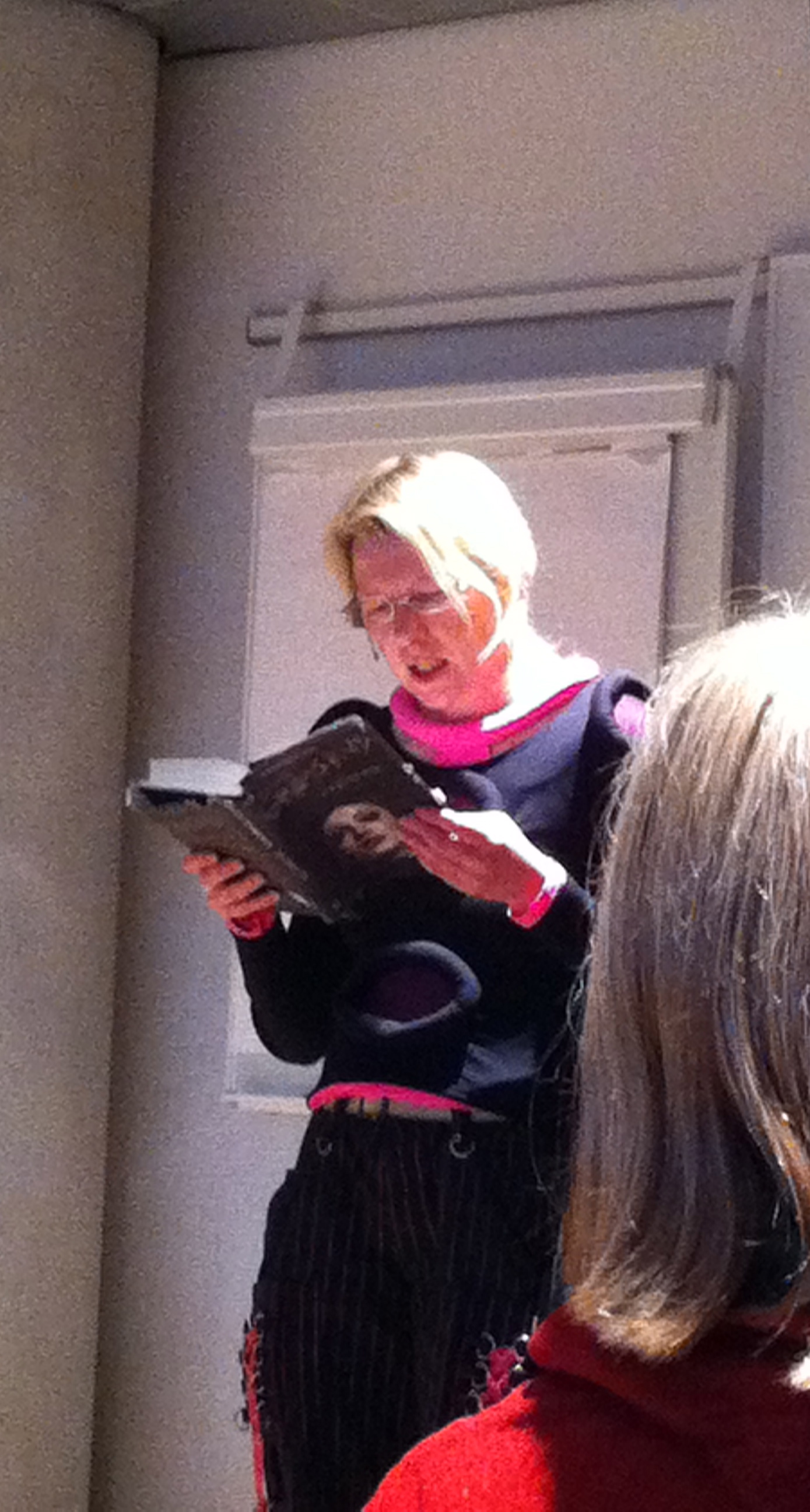
Beate Grimsrud reading from "En dåre fri"
A friend and I went to yesterday’s International Author’s Stage to experience Beate Grimsrud, the Norwegian, now Swedish-based, author of works like “En dåre fri” (roughly translated to ‘A fool free’) and “At smyge forbi en økse” (again roughly ‘To edge past an axe’).
As far as the Scandinavian literary scene is concerned Grimsrud has been very much talked about – she is one of the, lately many, author’s who have been highlighted for their use of autobiographical material to a level of extremely concreteness.
She has been awarded several prizes for her authorship and recently she was nominated by Norway AND Sweden for the Nordic Council Literature Prize of 2011. Something she noted at the event yesterday was not the advantage some would claim. But, nonetheless, impressive. And in Sweden her style has even become a term in its own: Grimsrudsk (Grimsrudian) – narrative with detours, sudden associations to other subjects etc.
She started by reciting from “At smyge forbi en økse”, which, I’ll admit, was muy impressivo. Either she has done this a lot or her works sit so embedded in her she can just pick pieces to recount in front of an audience.
Even though Anette Dina Sørensen (the interviewer) did most of the talking (she whipped up quite an analysis of Grimsrud’s authorship, kudos, both relating to queer theory, psychiatry, and autobiographical matter) what Grimsrud had to say was very much to the point.
Her project is to open up or break down the barriers and categories we are so quick to set up and upholding – leaving us constrained versions of humanity. Men, women, mentally fit or sick, child, adult.
When she read from “En dåre fri” people in the audience were nodding, laughing, sighing and acknowledging the narrative vivaciously – the experience was fascinating. When she read from her works the atmosphere in the room was like the audience became part of a single entity whose shared reciprocity enlivened the story Grimsrud told. Much in the spirit of what she argued about books: that they don’t really exist before they have an audience/readership.
She told Sørensen how writing for her was like a sprinter at a marathon – she poured all into a book, writing with fervor and when she thought she had given all she could she realized that she had 40 km left to run! OK, she said it much better, with the calm air of a writer, or maybe you should have been there to hear it.
Then they talked about the character of Eli, how Grimsrud used the ambiguous name so it would relate to men and women, and Eli’s schizophrenia that resulted in hearing voices, 4 male voices to be specific.
One little tidbit: did you know that “En dåre fri” in Norwegian is not the same as its Swedish counterpart? And that the Danish translator has meshed these two into the Danish translation? This is fascinating to me.
I have yet to read one of Grimsrud’s works, but I have a feeling that won’t take long – my fingers are already itching to use non-existing moneys on “En dåre fri”. We’ll see how long the struggle will be.
Have you read anything of Grimsrud? I would love to hear what you think about her books, authorship, themes.
Ted Talks
I have a very soft spot for spoken word poetry. And so I won’t write much in this post other than I recommend that you listen to and see this Ted Talk featuring Sarah Kay. Her poetry balances with extraordinary curiousness on the borderline between confidence and vulnerability that is fascinating to me. I’m not even sure there is a border between those two anymore.
Proudly presents:
Friday to Sunday you absolutely must come (if you are not restricted geographically or otherwise) to THE literary conference at KUA. The topic is “Literature in the Expanded Field” and there is lots to talk about. Look, read, and come!

Literature in the expanded field
(oh and by the way: I am one of the contributors to the student panels – so be there Friday at 9, if you want my pearls of wisdom).
I have taken the liberty to copy the program as it stands in Facebook Events – feel free to rsvp, share, invite, be inspired and spread the word.
_______
WHAT HAPPENS WHEN THE LIMITS OF LITERATURE ARE
Q U E S T I O N E D? C H A L L E N G E D? E X P A N D E D?
FIND OUT MAY 6th-8th, LOK. 21.5.54, KAREN BLIXENS VEJ 1 INSTITUTE OF ARTS AND CULTURAL STUDIES
S T U D E N T P A N E L S
about:
book covers, uncreative writing, sms literature, pattern poetry, street art, authorial originality, textual transformations, conceptual writing etc. …
K E Y N O T E S
Charles Lock
Tania Ørum
Charles Bernstein
Martin Glaz Serup
Marianne Ping Huang
Martin Larsen
Caroline Bergvall
Christian Bök
P O E T R Y R E A D I N G S
at Gyldendals Forlag,
Christian Bök
Ursula Andkjær Olsen
Lars Skinnebach
Anne Blonstein
Charles Bernstein
Cia Rinne
Caroline Bergvall
FRIDAY MAY 6 -Students’ conference and Readings by Students from The Danish Academy of Creative Writing.
Dramasalen 21.5.54
9.00-10.30 Textual Transformations
The challenges of literature today: Revolution, evolution or deconstructionof the literary traditions?
Amanda Egebo “What is a text? – Towards new theories of narratological understanding.”
Marie Louise Poulsen “Novel transformations. A historical approach to the possibilities of the novel genre in the digital.”
Charlotte Kirketerp “From author to writer – destructive stategies”
Jenny Johannessen “Reading the reader reading the text: Exploring the role of the reader in the transitional phase from print to digital text.”
10.30-10.45 BREAK
10.45-11.15: Readings by Daniel Dalgaard, Hanne Viemose.
11.20-12.50 When Literature and Image Meet
Mikkel Damkjær Paaske ”Judging a Book by its Cover.”
Shekufe Tadayoni Heiberg ” Pattern Poetry.”
Marie Nedergaard-Larsen ”Textual and Visual Interplay in Children’s Picture Books.”
Charlotte Sørup Lorenzen ”Picture Books and Avant-Garde.”
12.50-13.45 LUNCH
13.45-15.25 Sound Literature and Orality
Ditte Pradsgaard Holm “Tactility as Poetic Meaning?”
Jane Rud Pedersen “Orality in Hans Sydow’s Sagnsymfoni [Symphony of Myths].”
Alexander Vesterlund “The Poetics of Orality in “Vi sidder bare her [We’re just sitting here]”.”
15.30-16.30: Readings by Bjørn Rasmussen, Ursula Scavenius, Caroline Minor og Zoltan Ará.
SATURDAY MAY 7 – Students’ Conference and International Conference
Dramasalen 21.5.54
9.00-10.45 Reaching out Democratic (im)possibilties of literature in the expanded field
Naja Kirstine Kjærgård Laursen “Word on the street.”
Ulla Ewald Stigel “Homeless readings – the literary debate redistributed.”
Ragnild Lome “Literary expressions on Faceook.”
Signe Nordgaard Andersen “Literature to Go – sms literature”
Anna Eistrup “Reflections on Linguistic Consequences of an Expanded Notion of Literature in the Light of Cultural Politics.”
10.45-11.00 BREAK
11.05-12.45 From the Original Author to the Programmed Machine
Niels Udby Sørensen “The Restrictive Demands of Originality.”
Lærke Rydal Jørgensen ”The Art of Borrowing or the Crime of Stealing.”
Peter Eske Vinum ”Postproduction, Uncreative writing, and the Conceptual Author.”
Nicolai Koch, ”Conceptual Writing.”
12.45-13.45 LUNCH
13:45-13.55 Welcome and introduction/ Tania Ørum
13.55-14.25 Charles Lock ”Anne Blonstein: words and letters / the measure of space.”
14.25-14.55 Tania Ørum ”Danish Writers in the Expanded Field”
14.55-15.25 BREAK
15.30-16.30 Charles Bernstein, “The Present of the Word”
READINGS Gyldendal, Klareboderne 3, København K.
19.30- 22:00
Welcome / Tania Ørum
Christian Bök
Ursula Andkjær Olsen
Lars Skinnebach
Anne Blonstein
Charles Bernstein
Cia Rinne
Caroline Bergvall
SUNDAY MAY 8 – International Conference.
Dramasalen 21.5.54
12:00-12.05 – Welcome and introduction/ Tania Ørum
12.10-12.40 – Martin Glaz Serup “Documentary and pseudo-documentary in contemporary postproductive witness literature”
12.40-13.10 – Marianne Ping Huang Radiophonic space/place inprint/voice: on Charles Bernstein’s “I’m speaking to you from Princetown, Massachusetts” and Pia Juul’s Radioteatret (2010)
13.10-13.30 – Martin Larsen “Zoom into the Butterfly Valley – Notes on the Sigma
13.30-14.00 – BREAK
14.00-15.00 – Caroline Bergvall “G/hosting practices: excavations, encounters, the role of writing today”
15.00-16.00 – Christian Bök “The Xenotext” presentation of ongoing work with genetically engineered poem

On Instagram
