Posts in Category: The power of literature
Processing 9/11 – a Foer experience
I don’t remember what I did at 10 o’clock in the morning. But I remember the afternoon. That’s when my little TV in my little dorm room was turned on because I had received a very odd text from a friend, and it wasn’t even April 1st. It felt like April 1st, a very cruel Fool’s Day. But it wasn’t, it was 9/11, and from that day it became an expression, no need for explanation, it was just 9/11. I don’t remember what I did at 10 o’clock the next morning, but I do remember the afternoon past.
The reason I have gone back to this date is because I have just finished reading Jonathan Safran Foer’s ‘Extremely Loud and Incredibly Close’. I got it after reading ‘Everything is Illuminated’, because Foer’s style of and topic really hit home with me. And I was not disappointed. I was thoroughly plowing through a child’s universe filled with sorrow and a silver lining.

Foer - Extremely Loud & Incredibly Close
Center to the story is the little boy Oscar, a little boy who feels everything, incredibly and extremely. The loss of his father in the 9/11 attacks on the Twin Towers sends him on a scavenger hunt around New York in search of answers; answers that can tell him how his father died, what he should do, how he should react, who he is. His special bond with his father is severed and the need to find a way to process a reality that does not even seem real takes over. The traumatic loss is omnipresent in everything he thinks and does, and pervades every single page of Foer’s 355 pages novel. Everyone Oscar is in contact with is seen through the lens of loss and solitude. But he has his imagination and determination, which works both for and against him, it drives him towards seeking answers.
The immediacy of the storyline, whether it is Oscar’s travels through the boroughs of NY or his granddad’s letters, leaves me breathless. I think it is partly because this is the first time I have read a novel that is centered around the aftermath of 9/11, that is, not America or the States as a democratic nation or Western power attacked and fighting the Axes of Evil, but a novel about the personal experience of the attack; a boy who misses his father, the child’s take on 9/11. And Oscar just won’t let this event go, he can’t:
It makes me incredibly angry that people all over the world can know things that I can’t, because it happened here, and happened to me, so shouldn’t it be mine?
The novel works in circular patterns. The processing of the 9/11 trauma is underlined by a trauma of 20th century Europe: WWII and the bombings of Dresden. Oscar’s father ‘leaves’ him and his father left him before that. I get the feeling that everything works in weird, not necessarily connected but none the less, thoughtful patterns. You find yourself wishing that everything is connected in the great cosmos of life, regardless of time, space and human interference.
But Oscar’s experience is not the only thing that forms the novel. Foer has used a lot of techniques that make the novel more than a traditional “read letters = understand meaning” type of novel. There are pages that are filled with red ink circling random letters (a reference to how Oscar’s father spellchecks the New York Times), pages that are empty save for one lone sentence (as Oscar’s grandfather is incapable of speech, cause unknown, and communicates with “yes” and “no” tattoo’s on his hands or by writing everything down wherever he can), and pictures of some of Oscar’s different impressions. This is, in my opinion, both good and bad, because there is a lot of it going on in the book, and you need to see it both as part of, but also separate from the rest (if that makes sense at all 🙂 ). Foer’s style is secure enough in itself without all these gadgets, but it does add a little extra when you can reverse 9/11 at the end, and make a man fly upwards rather than falling down towards the ground, simply by flipping the last 10 pages.

Inside the book

Inside the book II
Euripides’ Medea
My holiday books are in a dead heat with books I have discovered in my mom’s bookshelves. I could have told myself that books were not a necessary item to bring with me on a trip home, but I got greedy. The latest raid left me with seven books in each hand and three in front of me. But incredo-woman as I am in the field of literary vice, I am able to multitask, so this weekend I have been reading Herta Müller’s ‘Der Mensch ist ein grosser Fasan auf der Welt’, Virginia Woolf’s ‘The Waves’, and Euripides’ ‘Medea’. Three completely different books, both in style and theme, and all three keeping me on my toes.

Raided books
MEDEA
I finished the copy of Medea first – it wasn’t that long, so it was a good night’s read – which I found out both my mother and my uncle read in high school. As I was reading it, I thought about the famous line “Hell hath no fury like a woman scorn” (originally from W. Congreve’s play ‘The Mourning Bride’ from 1697, but often misquoted as a Shakespearean line, it goes like this: Heaven has no rage like love to hatred turned / Nor hell a fury like a woman scorned.) I also thought about how you often toss it out whenever a woman gets angry to disarm or delegitimize a miffed out female. In the context of Medea it is also relevant to mention that Fury is a female spirit of punishment in Greek mythology (The Furies (Roman mythology) or Erinyes (Greek mythology) in the Underworld punish the guilty, and are avengers of violations of natural order, among these kinship murder). The story of Medea in Greek mythology is this: deeply in love with the warrior hero, Jason, sorceress Medea agrees to help him in his quest as long as he promises to take her with him and marry her. As many mythologies go, there are a lot of hindrances and creatures with different divine powers to be conquered. In the beginning of Euripides’ tragedy Medea, although now married to Jason, has been scorned by him in favour of the daughter of king Creon, in order to help his political status. So enraged by this treachery she wows to take a most gruesome revenge. Medea is known and revered in the land as a wise woman, and Creon genuinely fears her retaliation, so he exiles her, but she persuades him to give her time to find a new haven. Unknown to him, she has just bought time to concoct a plan to hurt Jason by killing his daughter. Jason himself goes to her to smooth things out, the first time of no use, but on the second visit she leads him to think she has forgiven his actions and wants to give his wife to be a present of a dress and a coronet. In fact, she has poisoned the clothes and in the most horrific way Glauce (Creon’s daughter) dies. When Creon touches her he is also killed by the poison. Two down, two to go, as Medea has no intention of stopping here. In order to really get to Jason, she also kills off their own children.
The tragedy is truly worth the read, it is pure spears to the heart, and the dialogues are beautiful, and each sentence is laden with moral and ethical food for thought. It truly is tragedy in its truest sense. The character of Medea, also the interpretation Euripides makes, has been an inspiration and topic of many men and women throughout history, not only literary history, but living history in general; her actions scolded, her passions revered, her sorrow felt and discarded, she truly is a being of great magnitude. The sacred role of motherhood is contested, she is cast into the role of a monster, and yet maintains an aura of pride about her. And there is always the question if her intelligence is a stumbling block or an asset – is intelligence of the mind or heart, or maybe a harmonious fusion of the two? Throughout the whole ordeal she holds her head high, places the full blame of occurring events on Jason, and seeks justice for her lost honour. She truly is complex, and although the play in itself, as I earlier said, is a quick read, the story is not easily out of mind. I suspect it will not be long until I go through the play again, and I would really love to see it played out, even if it could never stand ground with the impressive characters and scenery I have built up inside my head 🙂
Different images of Medea

Medea
Scene from a South African adaptation of Euripides’ Medea. Performed by Jazzart Dance Theatre during 1994-1996.
Directors: Mark Fleischman and Jennie Reznek
Photographer Ruphin Coudyzer.
Choreographer – Alfred Hinkel
Composer – Rene Avenant
Actor – Bo Petersen (Medea)

Medea

Medea about to kill her Children - Delacroix

Medea about to kill her Children - Delacroix

Medea killing her son - Vase
Nostalgia: Alex Haley’s Roots
When I was a kid I used to raid my mother’s book shelves after I had emptied the village library, and my own book club books were turned over about 4 times. Most of the stuff I read I couldn’t really fully understand in all their complexities, but there are a couple of books from her shelf that have stuck by me for all these years. One of these books was Alex Haley’s ROOTS.

Alex Haley's Roots
To sum it up in too few words, the book is a family saga, written by Mr. Haley about his ancestry and as a symbol of the Afro-American slave history. The name Kunta Kinte has buried itself into my memory and is a symbol of both the knowledge I, since this book, acquired of Afro-American slave history, and the focal point from which I have read literature of this nature. Alex Haley researched his family history for over a decade in museums and libraries around the world. What really stuck with me was when I read in the the last chapters just how important this story was for Mr. Haley, as he climbed into the cold cargo hold of the ship he travelled with from Africa to USA. He spent all ten nights down there, naked and freezing, in order to get an inkling of what his forefather went through, even how minor his experience could be compared to that of Kunta Kinte and so many of his country men and women. This sat with me, the amount of dedication to the story and how important it is to acknowledge something in order to process it. As much as I owe this book, and books like this one much for helping to build my character, sadly, this book also introduced me to an experience that I wish I could have lived without: shame over the color of my skin – shame over my cultural heritage and apparent standing in life. Irrational as it may be for a 12 year old girl, stuck in the middle of the Atlantic Ocean without ever having experienced or thought anything that could resemble any discriminatory act, the weight of the connotations that followed my skin color was heavy. How this could even be true, that you could take a human being, put them in shackles, transport them in pitiful conditions across the Atlantic Ocean, using them and abusing them in every manner, was so horrible a fact to come to terms with. I don’t know if the shame is a collective shame of the caucasian race in the Western post-modern world, or if it’s just because I’m an easy knock out, but it was very real during all my teenage years, that as much as I revered the great accomplishments of European thinking and philosophy, equally as much I was appalled by the darker corners. In later years, this shame has turned into anger and then to commitment.
Having said that, I am eternally grateful for having read Roots. I am grateful that I learned that there is hope of breaking the mould, that things are not doomed or static, that the most powerful things in life are not always easily seen, and that they take time. And most of all I am grateful for having been shown that the ubiquity of human determination and intelligence can surpass and find loopholes in all constraints.
Which book turned your world upside down and why?
Adichie’s women
You had just finished Adichie’s latest book and sat down to write a post to your blog about it. You had realized that it was drawing your mind towards yourself and the people and places around you. It was the summer you did not go to Roskilde Festival, the summer you finished early at uni and started late, the summer your mother was waiting anxiously for your arrival back home, where you belong, on the little islands in the vastness of the Atlantic Ocean. The islands very few people knew, and most outsiders deemed either breathtakingly beautiful when speaking of the nature, or backwards and stubborn when speaking of its inhabitants, of course they did not know the incredibly fabulousness of the society because they weren’t insiders. You were watching the sunny pavement outside and wondering what kind of weather would form your holiday visit to your homeland.
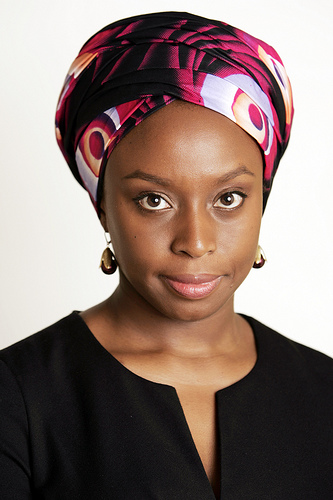
Copyright © 2008 Beowulf Sheehan/PEN American Center
Adichie speaks to me. The little section here up above is my own humble way of showing one of the narrational techniques she uses and the air with which she does it. She is a storyteller of refreshing confidence. The stories are pervaded with curious impressions of her women protagonists, who either are out of their cultural boundaries, relocated in geography or seeing new situations arise out of old settings. So many of these short stories deserve attention on so many levels but what most struck me (probably on a relational level) was the sense of being or existence on the one hand, and the quizzical reflection the narrators have on people who deny their culture and identity. There is a lot of emphasis on who someone is, and why someone is. What does culture mean, and how ingrown are you? Is it easy to change from one cultural identity or are you just posing, trying to fit in? When you no longer feel kinship with a former identity, do you feel shame, or do you scorn others for not evolving as much as you? Do you have the right to weave your own culture into someone else’s, to put your mark on it? All of these questions arose in my mind while reading Adichie, and all of the women are so beautifully human.
However, I also have some reservations with the stories. In general, the issue of race, and especially the multifaceted power issues between white and black, somehow always ends up in the same critique of the former and the self-negating puppet actions of the latter. The former is always displaying condescending attitude towards the latter, no matter if he means well or is trying to forcibly impose his ideas, and the latter takes the rottenness of the former and pervades himself with it. Granted, the issue is fraught with so much background by now, that no matter what stance you take, you take the wrong one. But it gets tiring, and I do wish (fairytales and pixie-dust) that we could move on, individual to individual, on more equal terms.
‘The Thing Around Your Neck’ did for me just what I want books to do for me: they opened a door into a realm I am not entirely aquatinted with and invited me to think (even if some doors were closed and some places were thought for me).
Telling stories
I have started to read Karen Blixen’s Seven Gothic Tales and I am really liking it. The first story ‘Roads around Pisa’ reminded me a lot of Don Quixote and how Cervantes playfully deals with sexuality and misconceptions that invite a reconsideration/reaffirmation of the cultural meaning of gender. There is an awful lot of reflection about women and their stand in life in Blixen’s tales. It is really fascinating to read when most of it narrates through the characters of men, and that which is narrated by women is done with regards to their station within the realms of society’s norm. The seven tales from the title are interspersed with many, many tales that use this power of narration to get their story out.
I am a firm believer in the idea that we sculpt our world through narration. The stories we choose to tell are our takes on reality as we perceive it, or in some cases how we challenge it. We accept and join in on some narrations, while we reject and replace others and in doing so we create meaning for ourselves. The characters of Karen Blixen are all trying to communicate their knowledge or view of the world through their tales. There are those in her character-base who create stories that are double-edged, recounting past experiences with present knowledge (older, wiser attitude) while forming their explanation by present outlook. And then there are stories that attempt to incite future action, stories that distress, stories that bring joy and stories that contemplate life’s fickle nature.

Karen Blixen - Syv Fantastiske Fortællinger
Narration has a great power over humans. We relate to each other when we tell tales and listen to stories of others. We invite others to see what we see and use stories to understand others, and mostly ourselves. Telling stories is a very common pastime in my family (both immediate and extended). There are some great storytellers among them that capture their audience with exhilarating stories, and it is of no matter how often we have heard them. It is not so much the story per se, as the setting, the way the story is being told and the feelings that the storytellers convey that have an effect on the listener. Without being told to ‘laugh here’, ‘cry here’, or ‘be shocked here’ you use all of your sociocultural learned skills on picking up signs and identifiable markers.
I guess this inclination towards stories and narration in my family has been naturally conveyed into the wonderful world of literature for me. I feel at home in processing stories and using my skills to look at a text not as an inanimate object that is merely to be read or seen, but a living creation always up for interpretation and always experienced by the next listener/reader in line.

On Instagram
