Posts By Penciltwister
And the winner is…
It pays to be totally maniacal when it comes to checking websites that give ‘free’ stuff away. Last week I was quick enough to be one of the five fastest to volunteer at DR’s Testklubben to review ‘Sumobrødre‘ by Morten Ramsland. The prize? One copy of the book, free of charge. Score! I am starting on it today, and on the 22nd it will be introduced on ‘Smagsdommerne’ (a review program on DR2), and the site will open up for reviews.
The only other time I have won something was when I was about 15. It was a copy of MJ’s ‘Blood on the Dance Floor’, and I was over the moon with excitement. I didn’t even remember entering the contest, and the feeling of receiving something by a chance draw is really special. It’s a gift, but a gift from someone you don’t know, and only because you actively did something. But you did something, and it paid off. High five myself, applause from the audience and an inner smile for the rest of the day. Lovely!
Back to the book: I will be posting my (translated) review of the book on my blog as soon as I finish it. (And here it is)

Ramsland - Sumobrøde
Just as an initial comment; I don’t like the cover. And it has nothing to do with the giant toad, which I actually find charming, or the font (Minion, to you font lovers out there). Due to poor photography skills I have not been able to capture just how yellow the cover is, but I can assure you, it is mighty yellow. Screaming neon yellow to narrow it down a bit. And it hurts my eyes when I try to read the bloody letters because they are baby blue and black, and… so many contrasts, but hopefully my only concern regarding this book.
I have previously read ‘Hundehoved’ by the same author, and keeping in with the times of family narration, the generation saga, it was really well written. So there you are!
I am on a mission: two days, 255 pages, 1 review report and a, until further notice, sufficient amount of coffee to keep me going.
Inherited shame
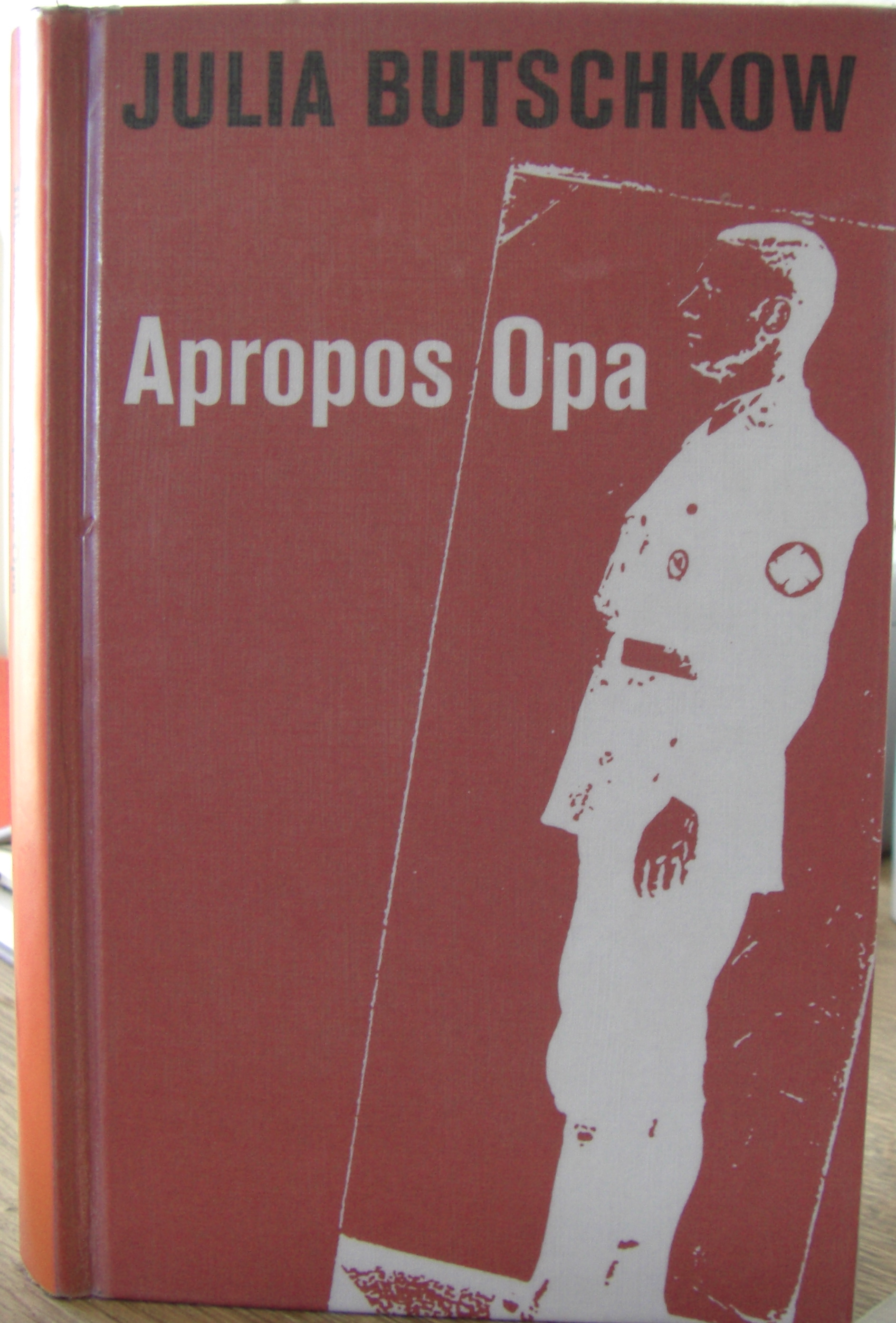
Julia Butschkow - Apropos Opa
Julia Butschkow has enrolled in the field of post-WWII literature with ‘Apropos Opa’, a story about a depressed woman working in a watchmaker shop, because studying literature at the university was too much.
Her father has ‘fled’ to Denmark from Germany and all that it stands for, denouncing it’s, and more importantly his father’s existence, while working at being as Danish as possible. She, an emotionally confused and apathetic woman, her father, psychologist and womanizer, and last but not least her grandfather, a (former) SS-officer turned alcoholic with bad parenting skills, form a basis for this novel that takes the reader from the end of WWII up to present day in shifts.
Butschkow writes in a minimalistic style that gets straight to the point or doesn’t at all. Chapters are short, and so are sentences. Sometimes there is the impression of something left unsaid, but existing very much in between the lines.
There is off course the obvious theme of guilt and shame where different mentalities lead to different solutions to the problem. The notion of being German (fully, partly or denying it) after WWII is a very complex entity. The questions ‘where were you during the war?’ or ‘what did you do?’ are so painful that some don’t want to be asked and others don’t want to be told. There is a process of rewriting your life or adapting it in unfavorable circumstances. How to deal with the fact that your father/mother/uncle was a Nazi, and knowing that there are several others in the land who must deal with the same fact, but no one is talking about it? Well, these days everyone is talking about it, through it. And Butschkow’s novel is a great input to the field. Also for the particular reason of the narrator being part German, part Danish. The narrator is being made aware of the negativity in her German heritage because of the way, for example, her Danish grandfather talks about them. She is ashamed without knowing exactly why.
The psychology goes further, because she also takes on the role of emotional caretaker to her father, thinking that no one can protect or understand her unstable father as she can. The scenes Butschkow describes of the narrator as child are heart-piercing and support the whole mental status of the grown up narrator. She is very emotionally attached to her father, which sometimes borders on a negative dependency. I get the feeling that she has never had her Oedipal moment with her father and thus doesn’t have a clear line between herself as individual and her father. In one part of the book she explains how she feels she and her father are in symbiosis, she feels what he feels, and reacts almost with physical distress if he is in a bad mood or uncomfortable.
And although she is center in the novel, it is very much a story of the father and grandfather as well. We are privileged in ‘knowing’ the narrator’s inner thoughts, but must draw conclusions about the other two on the basis of her memory and reenactments. And even though the judgement is on the basis of a proxy there is much to read from the three generations.
The story reads in parallels: father-daughter relationship, father-son relationship, dependency-autonomy, Danish-German, guilt and denial, etc. And there are continuously aspects worth analyzing and debating, so this has only been a few pointers.
This was a good read.
Celebration!
Today is my cousin’s 30th birthday. 30 years on this globe that’s ever spinning around the sun at a mind-blowing pace.
It is interesting that we put so much emphasis on defining some days and events as more important than other. 29 is totally boring, why bother mentioning it, unless it is to mark your last steps in the 20’s. To some cultures 18 is a big deal, while the same connotations circle around 21 in other cultures. We like years and dating events so much we have filled whole encyclopedia’s with them. It is fascinating that we (or some of us) equate current events with former ones, as if by power of likeness in numbers they have something in common. Or is it just the nostalgia? Does one particular date allow for reminiscence, that the day or month before or after could not afford? Do we need to pin point when we remember, say the birth of a new nation, or the assassination of Lincoln (which would be today, for all of the history lovers out there, yet technically he died tomorrow, 145 years ago!).
I suppose we won’t ever stop reminiscing or being nostalgic, and I think maybe we think ourselves a bit absolved when we honor and ceremonialize events we didn’t or couldn’t do better at. My tiny wish for the people of the world (hoping not to sound too much like a Miss World candidate) is that they from time to time open their eyes to the current events and do, not close them and think.
And to my cousin; a very happy birthday, with lots of gifts and celebration and reminiscence and nostalgia awaits hopefully, with many more to come 🙂
Hunger
A couple of weeks ago I finished Knut Hamsun’s Sult (Hunger). It has one of those epic starting lines that are so rare these days, probably because they either reek of cliché’s or have already been taken.

Knut Hamsun - Sult
“It was during the time I wandered about and starved in Christiania: Christiania, this singular city, from which no man departs without carrying away the traces of his sojourn there.”
(quote from the English translation by George Eagerton).
Unfortunately, in my opinion, the translation of the last part (from which no man departs…) doesn’t really emphasize the fascinating brutality of city life. I would rather translate it “from which no man departs until it has marked him”. The emphasis here is that the city has a hold of you, it devours you, and IT decides WHEN you are good and ready to go on.
This corresponds well with the city as literary image in the late 19th century (Hamsun’s Hunger is written in 1890). The city, now well versed in fast pacing revolutions in the fields of science, literature, physics etc., is always one step ahead of the individual who struggles to fit in and keep up. Thus began a new era of social misery: the individual of the early 19th century, the aristocratic dandy (a flaneur observing the city), is replaced by a stressed out, overstimulated wretch.
In Hamsun’s Hunger the protagonist is such a character. All of his experiences are interspersed with Christiania as a city and the people who inhabit such a place. And he struggles. He struggles to survive in the city, while the ramblings of a ‘mad-man’, a hungry and homeless man without a lifeline in either direction, are being flung out at the reader. Our protagonist alternates between paranoid and hopeful within pages. The darkest pit is replaced by the bluest sky depending on the way the wind turns. His survival is dependent on money, a trade of capitalist society, and his income is dependent on his writing skills. But the hungrier he gets, the harder it is for him to keep his thoughts in order. At first his work is accepted, giving him enough money for a couple of days of lodging and some time to recuperate, but he has no sooner become hopeful than he is out on the streets again. And thus starts a new round of misery. It is truly a work of great significance, and it would do people well to read, especially in these days when you hear more and more about the abuse of homeless people on the one side, and the overbearing laissez faire-“the state will take care of them”-attitude.
Sofi Oksanen
On March 30th the Nordic Council Literature Prize 2010 was awarded to Sofi Oksanen for her novel Puhdistus.

Sofi Oksanen - Renselse
I had planned for a long time to read it, as I read an interview with her and several reviews that spoke highly of the novel. Usually I don’t select my readings by reviews, but everything I read, both on and in between the lines, hinted at something special, so I reserved it from my library as soon as I could (and ended up only no. 24 in line!). I finally got it and read it in two days. I know it is every publisher’s press release orgasm wording, but it sucked me in and wouldn’t let go until I had read the last sentence.
The novel takes place in Estonia, where an elderly farmer woman Aliide finds a woman called Zara, a trafficking victim, battered and bruised on her property. The women’s different yet similar histories are told in a very harsh but poetic way. Every imaginable pain, guilt and shame that can befall a woman both in a political dictatorship and tyrannical misogynistic rule is present. But just so it doesn’t all become one color, the story also tells of pride, survival instincts and imagination. And it made me angry, it made me empathize and gag and smile and nod agreeingly. There were so many layers of female thoughts all coming together in the novel. And I say female thoughts, not to say it is an entity far from male thoughts, but only to emphasize that the novel deals with the female experience of a system set in order by men, in which it is almost impossible for them not to step outside the line and get penalized. Male dominance is pervasive and his sexuality is being used as a weapon against, and on, women in ways that make you cringe.
Something I found very interesting was how Aliide’s jealousy of her sister manifested itself in the book. It is, for lack of a more appropriate word, beautifully described. It represents a woman engulfed in her sisters assets and successes so much that her sister almost gains a divine glare, a virginal innocence towards all evil thought and behavior, only thence to manifest darkness so more blatantly in Aliide.
She is such a complex figure in my mind, and yet so cliché when it comes to the failures in sisterhood. Aliide knows what she wants, and she is determined to get it at all (and I mean seriously at ALL) costs. I think she represents a figure who balances on the very fine edge of desire and survival. She is determined to survive, even if that means that she has to give up so many things that could enrich her life. She survives but at a cost. Is it society’s fault? Men? Her own or her family’s?
And when she lashes out, takes control of her life, person and property , it is almost as if it is too little to late, or in a totally exaggerated way.
Another interesting and reoccurring scene is when the women experience assault and their mind, in survival mode, takes them out of this threatening situation. Being the little piece of dust or a fleck of light on the hard cement floor, fleeing into a hole in the wood, and with every sentence being read you, the reader, are painfully aware, but not explicitly told of the horrors that are inflicted upon them. I can’t recapitulate the intensity of these passages with as much fervor as Oksanen does, but they are worth the read.
There is so much to delve into in this book, so much to emphasize, but I don’t want to make this too long. Safe to say, I will be picking this book up again at some point in time.

On Instagram
