Monthly Archives: October 2011
The New E-deal
 From the 1st of November 2011 and for one year initially a new e-book deal will make it possible for readers and lenders to borrow e-books from the Danish libraries, effectively eclipsing the previous one. The project is funded by the Office of Library and Media and partnering with them are among others the six central libraries in the country, Denmark’s largest publishing houses – Gyldendal and Lindhardt & Ringhof (and also Rosinante, an independent corporation within the Gyldendal-conglomerate) – and the distributors DBC and Publizon (the latter is owned by, drumroll please: Gyldendal and Lindhardt & Ringhof). (1)
As with paper books the lender gets the e-book on a 30-day loan and the e-book will be protected by DRM. The deal has been a long time coming, partly because the different participants had a hard time negotiating the pesky details, such as how much money the author’s and publishers would get per e-book download. And while it has received the seal of approval by the Danish Writer’s Association (DK: Dansk Forfatterforening, DFF), the deal has already conjured up quite a lot of criticism.
Who get’s to play?
One big aspect is the publishers: it is probably no surprise that the publishers involved in this deal are the hard-hitters of the business. Now, full disclosure, a great deal of publishers were asked to join in on the negotiations, many turned it down. These two publishers are effectively the only ones with enough power at the moment to sync money behind the project and simultaneously offer a vide array of titles which combined gives them pretty much the run of the place, publishing-wise. In a letter to an author, Gyldendal explains their reason for going into this partnership as such:
»E-books should be available where the reader is. But free reading via the libraries must at the same time not cannibalize the digital market we are in the process of establishing, where the author and publisher are dependent on the price of a book.« (2)
The fact that they are the only ones and so are representing the publishing area of the deal means they set the ground rules that other publishers will play by in later stages, not to the liking of said publishers. A deal of this magnitude, I feel, is something that should have been orchestrated at a level where governmental institutions were the initiators and deal-creators, to ensure that it doesn’t become about favoring one publishers demands over another, and also so that these publishers who are in on the deal can’t be held accountable for the points of the plan. Instead the management of the deal is done at a more local level – the previously mentioned six main libraries. And while it is true that Gyldendal and Lindhardt & Ringhof hold a majority of the titles that are being published in Denmark, they are not representative in nature of the Danish publishing industry. It therefore seems a bit off that they would call the shots in regards to what the lenders can or cannot lend at their local libraries. (3)
The money issue
Next up is the criticism that the loans will be to expensive for libraries – see article in Politiken about prices – although at DFF’s webpage it states that payment will be no more than that of a paper book with a calculation of approximately 40 loans per book. The Librarian Association does however think the model is too expensive.
The chairman of the Librarian Association, Pernille Drost, says to Bogmarkedet:
»The price is too high. The publishers justify the high price by saying that they don’t want to risk a drop in the purchase of paper books. But I think the high price means that many libraries will not have enough money to subscribe to the service, because the economy is just not there.« (4)
The setting of the price is done by a so-called staircase model, meaning the more the book is lent the lower the price of the book will be. Any and all books under 12 months start out with 18,50 DKK pr. lend pr. book. (5) It is then up to the libraries if they want to set limitations of number of loans pr. book, giving them the authority of decision locally. I would not feel comfortable proposing any other model at this point, but I do tend to see a great deal of critical points that will work rather excluding in regards to smaller and alternative publishers, and with the more and more diminishing chunk of money that goes to libraries I could see that local libraries would have no chance to offer their lenders the same service as other libraries. This last fact alone is very troubling to me, since the great tradition of public libraries is too important a service organ to be sucked into the power play of market wave-riding.
Looking with anticipation to future developments in this case.
___________________________________________________________________________________________________________________
(1): Toke Riis Ebbesen has written a very good entry about the news here (note: it is in Danish)
(2): The letter is in Danish and is available at DFF here.
(3): More on the deal by Søndag Aften here.
(4): Bogmarkedet interviews the chairman of the Librarian Association here.
(5): Angermann writes an entry calling for local deals in e-book lending – read it here.
Nobel Prize in Literature 2011
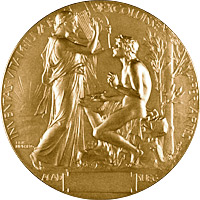
Update: Tomas Tranströmer, nobel laureate.
The man with his very own literary prize, Tranströmerpriset (established in 1997, with a money prize of 100,000 SEK), has just been awarded the Nobel Prize in Literature 2011. Tomas Tranströmer has been a popular guess for the Nobel Prize for quite a lot of years along with Syrian poet Adonis. His poetry has been translated into over 60 languages. The commission explained their choice as follows:
The Nobel Prize in Literature 2011 was awarded to Tomas Tranströmer “because, through his condensed, transluscent images, he gives us fresh access to reality.”1
Tomas Tranströmer was born in 1931 in Sweden. The Nobel Prize in Literature went to Maria Vargas Llosa in 2010, and other Nobel laureates include Günter Grass, Pablo Neruda, John Steinbeck and the very first Nobel laureate 110 years ago, Sully Prudhomme, in 1901.
______________________________________________________________________________________________________________________
The committee will announce the Nobel Prize in Literature at 1 pm CET and it will be streamed on Nobel.se’s website.
A lot of people are betting on popular names such as Murakami (Japan) and Bob Dylan (USA), and of course there are the recurring names Adonis (Syria) and Tranströmer (Sweden). Who do you think will be this years winner?
1: “The Nobel Prize in Literature 2011”. Nobelprize.org. 6 Oct 2011 http://www.nobelprize.org/nobel_prizes/literature/laureates/2011/
Wishing upon a portmonee
Ok, so you have to know this. It’s valuable information for future reference and you might just get that next dream job if you read the following text:
If this was a book wish list, I would wish for these:

- VE3 Composition No. 1 by Marc Saporta : yet another fabulous book made by Visual Editions, the same publisher that made Jonathan Safran Foer’s Tree of Codes. It’s basically a box of loose sheets of paper, and the point of this whole exercise is that you decide how you read it, not some upper-managment-book-editor/writer-type, YEAH! Down with progressive narrative!
- Unclean Jobs for Women and Girls by Alissa Nutting : not sure if it is a type of appraisal of shitty jobs for women or what, but I am drawn to it simply because of this title. Although it might say something slightly less positive about my critical sense, I am open to the idea that it just might blow me away.
- Go the Fuck to Sleep by Adam Mansbach : a pissed of parent who is not afraid to swear at kids before speech centers have evolved, how can you not read that, it’s so in these days to express in books just how annoying your kids are. Self-theraputic and letting us childless know that those who have are fully aware that they have stupid babies…. I said it…
- Fear of flying by Erica Jong : I just have to see if I too will have an epiphany.
- 1Q84 by Haruki Murakami : is it riding on the tail feathers of George Orwell’s 1984? Yes. Is it important that it does so? Maybe. Doth me mind? Noooot at all. I went to see the movie version of Murakami’s “Norwegian Wood” yesterday, and it is highly recommendable. One of those movies you could watch more than once, just to see if it had changed since the last time.
- Bernhard Hvals forsnakkelser by Lars Saabye Christensen : I am a sucker for the anti-hero, and am hoping this guy can tell me something I don’t already know.
- Huden er det elastiske hylster der omgiver hele legemet by Bjørn Rasmussen : ever since I read the review by Tue Andersen Nexø in Information, I have been gripped. This is definitely a book I want to get a hold of and experience first hand.
- Folkets Prosa by Rasmus Graff : taking the dictionary that has been a part of almost every household, and compose a book out of the seemingly random/weird/archaic/non-practical sentences that exemplify the words. What is the point of life if not a study in the complexity and sometimes alienation of language?

On Instagram
