Monthly Archives: February 2011
Spew your lunch, your history and your language on me

Stalin's Cows - Sofi Oksanen (front cover of Danish version)
Sofi Oksanen, I wish I could read Finnish so I could read your debut novel in its originality. Not that the translation was bad at all. It’s just… I feel there is something embedded in the language itself, that cannot be translated and understood at all. Like I have read a story that has so much cultural baggage, that this novel alone cannot satisfy my knowledge on the cultural/political aspects of this novel. And language (or expression) is a very important part of ‘Stalin’s Cows’. Language is identity and culture, it is something that both manages to distinguish you from and unite you with others on different levels. And when there is so much stigma attached to your heritage you go on the fence. But the narrative is interspersed with snippets of utterances in Estonian, Russian and Finnish that arrest my journey. And so the whole idea of denying someone the use of language, the right to express through language a part of one’s identity, proves to be futile; it wants out, it gets out, it finds ways no matter how hard you try to cover it up.
Sofi Oksanen, if I wanted to do my project justice I would sit myself down with an encyclopedia (old school), history books, essays on cultural transposition, and a dictionary, so I could tear the novel apart and let it percolate through my mind. It’s not just the words, but the enormous baggage and memory that lies behind them I want to get to. There is literature that wants to investigate itself on its own premisses, and then there is literature that needs words to give up their own agenda and become translucent – still autonomous, but hinting at another level, often in need of a personal voice, a subjective form to utilise language. And then, language is really just a conveyor belt.
Sofi Oksanen, the way you decide to delve into the logic of an eating disorder fascinates me. Dealing with it all cool and distanced, on a theoretical level, a tour de force in self-delusion, you chose latent communication. What does ‘Stalin’s Cows’ want to say? Is self-preservation, the physical minimum-survival-excistence, above all other aspects of life? If you spend your whole time making escape routes, creating a persona or shell, denying your identity in the process, the most engaging part of the day will not be how to live in the world, but how to endure yet another day in your own body. The logic of the eating disorder spirals through and through in Anna’s obsessive expositions and the language of food consumption and paranoia shrouds every day, every encounter, every meeting and flashback.
Sofi Oksanen, thank you.
Electronic, conceptual, visual, concrete, structural literature, literature, literature
Last week another semester started at uni, and this time I will be delving into the vast field of literature as more than just the piece of text inside a book. On Thursday we were introduced to the semester plan and the curriculum with bonus literature.
The course is really fascinating. When I first read the course description I didn’t really know what to expect, and only had a vague idea of what the “expanded field” of literature covers. I have talked about the e-book before on my blog, but more as a concrete tool for reading a piece of text without anything extra to it, or introducing the possibilities that come with an electronic book. The e-book has spawned new directions for literature and at the same time reintroduced the book as physical form and an integral part of the context where no text can stand alone.

Shadows never sleep
One take on the e-text is taking advantage of the multi-touch function of smartphones or tablets. Aya Karpinska has created a children’s story, a so-called zoom-narrative, where you use the zoom function to maneuver around in the story. It’s an app that can be downloaded to your iPhone, and there you can explore and create your own paths through the narrative. The story is called Shadows Never Sleep and there is also a demo video.
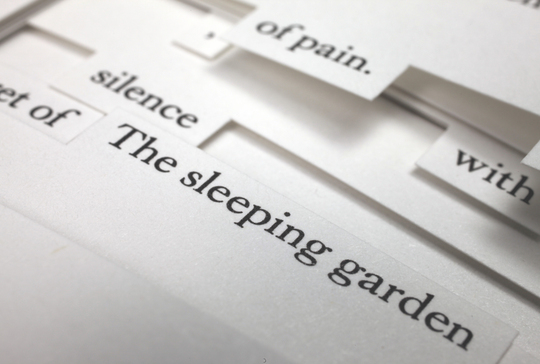
Tree of codes by Jonathan Safran Foer (photo from Visual Editions)
In the physical realm there are creations such as Jonathan Safran Foer’s latest book, Tree of Codes, which combines the visual and the tactile with the cognitive. There is more than continuous text on page after page after page. What he’s done is he has taken a novel by Bruno Schulz and made his own story out of the already-existing words by cutting chunks out of the “original” and the pages therefore are fragmented. It is a piece of text that is much more, that takes into account its physical presence.
Cue hypertexts and the children of the digital age, children in a way that you get to play with the internet, try its boundaries and piss people off by not abiding to rules and regulations. Today (and I have like 143 tabs open, my computer is ready to give up, and I don’t have enough time in the day to read all of them, so I am on a continuous journey that takes me longer and deeper into different corners of literature+art+internet) I found Jane Wong/Joe Davis with Ways to carry you, and Jason Ockert/Mattias Dittrich Shirtless Others. I will not say to much about it, except invite you to try it, see what you think. And then there is Kenneth Goldsmith’s Soliloquy, which is an unedited transcription of everything Goldsmith uttered in one week of his life. It’s quite funny to browse through.
UPDATE: I keep finding new stuff, but this last one is so good I have to make an update and include it: it’s Seoul based web-art group Young-Hae Chang Heavy Industries. They make text animations with funky music, you have to check it out. I stumbled onto Dakota (a reading of Ezra Pound’s Canto I & II), which is linked here, and a transcription here, but there is much more if you go to the mainpage: http://www.yhchang.com/
I picked these (sorry) almost at random, just as an introduction to the vast amount that is just lying out there, and all my tabs are waiting, nay pining, for me to explore them (as I assume, of course, my tabs have emotions resembling that of humans, and not, as I heard at a party, fish, who have no feelings and thus can be eat by vegetarians, over and out).

On Instagram
