Posts in Category: 2010
Exams: oh how I am going to miss you, the stress and the crammed-into-the-last-few-days-creativity
Deadlines are coming up real fast, and I am getting nostalgic about something that doesn’t have the proper distance in time to deserve being called a nostalgia, since I am right in the process, or actually not even started. Yes it is the exam, the nerve-wrecking, yet exhilarating time of the year when all you knowledge in one micro(yet strangely feeling very macro at the time)subject is being put to the test. How do you organise it, structure you paper or oral exam, how do you keep cool, calm and collected. I personally can first be structured and organised when I have enough little time to spur me on, but not too much time to make me lazy. Don’t get me wrong, I like simmering a topic for months and months on end, but it’s all in my head and doing all sorts of quirky shortcuts and elaborations before I get it on paper and finish it.
This year I am taking two courses, one on Strategic Communication and one on Modern Chinese Literature. And the strangest thing about it; I can’t agree with people who are almost ready to take over the university and declare exams as a thing of the past. The university, like many other workplaces, expect to see some results from the investments they put in the semester, and I do believe that you become a more diverse thinker in the process. I am however not always in agreement with the end result being the most important, on the contrary – the best thing about the exam is the process, the way you tackle the time, the effort you put into it, and the other events and people who inevitably demand your time as well. There is always the risk, for instance at an oral exam, that the nerves get the best of you and all the hard work you have put into it goes out the window. There is also always some numskull who hasn’t followed one single class, or done anything other than intensify coffee consumption at lectures, who walks away, acing the whole lot every single time, while you scramble notes, thoughts and work in a puree of meltdownish actions of panic.
Anyways, to get back to my exams – I am psyched. I got ideas (too many of them), time, place, creativity, I am on the top of the motherblipping game. I brainstorm, scribble, read, feel the university saga of academia running through my veins, I am Student!! I guess it is the hope of hitting the mother of all exams, the one where nothing is left unsaid, no stone unturned, no question unanswered. Expectations are high, but so are standards. I stand with great anticipation at the doorstep of another great challenge in academia.
Wish me luck…
“Everybody was beating each other up. The whole neighborhood was a war zone.”
Sumobrothers, p.15 (Danish version here)
In my opinion, Ramsland’s ‘Sumobrothers’ can be divided into two.
Section 1: a little more than half of the book. Totally submerged in physical and emotional violence, sadism, sexual assaults, brutal parents, lacking parents, frustrated parents, frustrated children, and last but not least a whole pile of brutal children without an off-switch of any kind.
Section 2: around the last third of the book. Ramsland is himself getting tired of all the violence, and doesn’t really know anymore which kinds of perversity and misery he can dish up without it getting trite. So he resorts to an emotional revelation concerning the state of things when everything is so submerged in violence, seen from the perspective of a child.
Ramsland’s literary style is very intriguing. He sticks to, most of the time, a naive style (something like Norwegian Erlend Loe) that supports the fact that we are seeing these experiences through a child. Or how a grown up would imagine the thoughts of a child would be formed in sentences. And that is in it self a scary perspective. Because there is nothing naive or childish about the experiences that are being narrated. There is no sign of a happy family, or a happy childhood, it is actually very hard to even find one single happy day in the entire book. The style corroborates in showing the brutality these children are captured in.
Having said that; I have written notes while reading the book, both in the shape of impressions and quotes. And when I read them through and think about the whole of the book and its message, I must say that it borders on splatter movie technique. The apparently regulated, but in reality totally unmotivated brutality and sadism that is going on between children, children to animals, parents to children, children to parents etc., is way over the top. I am genuinely scared that I am reading an instructions manual on how to raise sociopaths. I am, to say the least, surprised that half of the characters don’t perish during these 255 pages of violence. And this leads me to believe that Ramsland, when it comes to the subject of violence (no matter who it is against, or in which context), is making light of the seriousness of a violent environment. It is really not necessary to have 34 chapters on how everyone is beating everyone with the most innovative techniques to convince the reader, that violence is an incredibly subversive factor i any society. The physical exposition of the novel appears almost without reflection. Only now and then the narrators angst and reflections come to the surface, and we are truly being introduced to what goes on in the head of someone who plays tennis with a toad for a ball.
It is in all fairness a good novel that becomes too obsessed with the concreteness of violence description, because the stories that are behind all this violence are worth telling. There is the depressive dad, who has given up the life of an artist in order to becoming a traveling shoelace salesman and ‘dead-beat dad’. The frustrated mother, who is rejected by her sons solely on the basis of being the stable parent. And last but not least the children, who are only trying to find out what is going on between every unsaid action and where/how they fit in. I want to read more about that. But please turn down the violence a bit.
And the winner is…
It pays to be totally maniacal when it comes to checking websites that give ‘free’ stuff away. Last week I was quick enough to be one of the five fastest to volunteer at DR’s Testklubben to review ‘Sumobrødre‘ by Morten Ramsland. The prize? One copy of the book, free of charge. Score! I am starting on it today, and on the 22nd it will be introduced on ‘Smagsdommerne’ (a review program on DR2), and the site will open up for reviews.
The only other time I have won something was when I was about 15. It was a copy of MJ’s ‘Blood on the Dance Floor’, and I was over the moon with excitement. I didn’t even remember entering the contest, and the feeling of receiving something by a chance draw is really special. It’s a gift, but a gift from someone you don’t know, and only because you actively did something. But you did something, and it paid off. High five myself, applause from the audience and an inner smile for the rest of the day. Lovely!
Back to the book: I will be posting my (translated) review of the book on my blog as soon as I finish it. (And here it is)

Ramsland - Sumobrøde
Just as an initial comment; I don’t like the cover. And it has nothing to do with the giant toad, which I actually find charming, or the font (Minion, to you font lovers out there). Due to poor photography skills I have not been able to capture just how yellow the cover is, but I can assure you, it is mighty yellow. Screaming neon yellow to narrow it down a bit. And it hurts my eyes when I try to read the bloody letters because they are baby blue and black, and… so many contrasts, but hopefully my only concern regarding this book.
I have previously read ‘Hundehoved’ by the same author, and keeping in with the times of family narration, the generation saga, it was really well written. So there you are!
I am on a mission: two days, 255 pages, 1 review report and a, until further notice, sufficient amount of coffee to keep me going.
Inherited shame
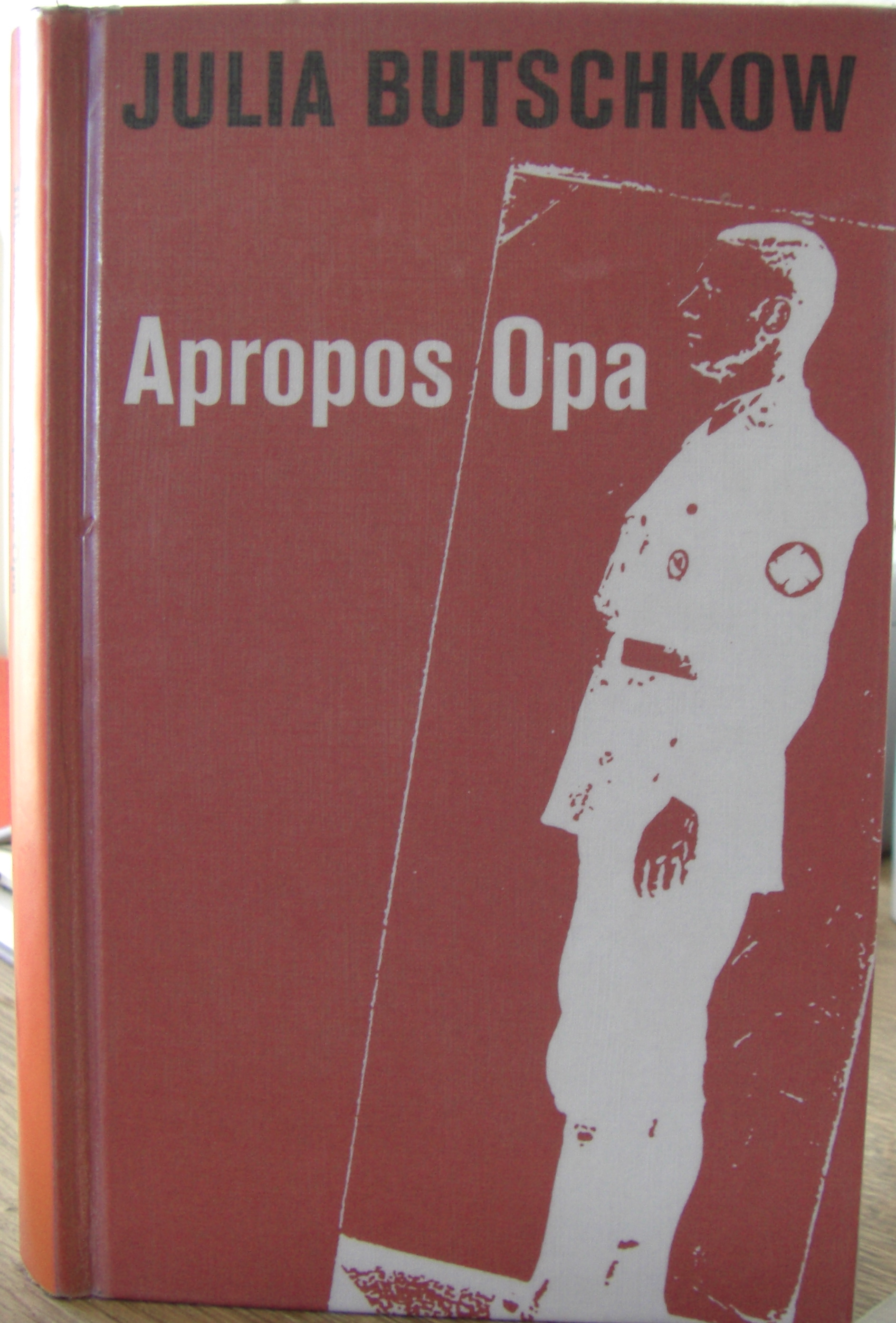
Julia Butschkow - Apropos Opa
Julia Butschkow has enrolled in the field of post-WWII literature with ‘Apropos Opa’, a story about a depressed woman working in a watchmaker shop, because studying literature at the university was too much.
Her father has ‘fled’ to Denmark from Germany and all that it stands for, denouncing it’s, and more importantly his father’s existence, while working at being as Danish as possible. She, an emotionally confused and apathetic woman, her father, psychologist and womanizer, and last but not least her grandfather, a (former) SS-officer turned alcoholic with bad parenting skills, form a basis for this novel that takes the reader from the end of WWII up to present day in shifts.
Butschkow writes in a minimalistic style that gets straight to the point or doesn’t at all. Chapters are short, and so are sentences. Sometimes there is the impression of something left unsaid, but existing very much in between the lines.
There is off course the obvious theme of guilt and shame where different mentalities lead to different solutions to the problem. The notion of being German (fully, partly or denying it) after WWII is a very complex entity. The questions ‘where were you during the war?’ or ‘what did you do?’ are so painful that some don’t want to be asked and others don’t want to be told. There is a process of rewriting your life or adapting it in unfavorable circumstances. How to deal with the fact that your father/mother/uncle was a Nazi, and knowing that there are several others in the land who must deal with the same fact, but no one is talking about it? Well, these days everyone is talking about it, through it. And Butschkow’s novel is a great input to the field. Also for the particular reason of the narrator being part German, part Danish. The narrator is being made aware of the negativity in her German heritage because of the way, for example, her Danish grandfather talks about them. She is ashamed without knowing exactly why.
The psychology goes further, because she also takes on the role of emotional caretaker to her father, thinking that no one can protect or understand her unstable father as she can. The scenes Butschkow describes of the narrator as child are heart-piercing and support the whole mental status of the grown up narrator. She is very emotionally attached to her father, which sometimes borders on a negative dependency. I get the feeling that she has never had her Oedipal moment with her father and thus doesn’t have a clear line between herself as individual and her father. In one part of the book she explains how she feels she and her father are in symbiosis, she feels what he feels, and reacts almost with physical distress if he is in a bad mood or uncomfortable.
And although she is center in the novel, it is very much a story of the father and grandfather as well. We are privileged in ‘knowing’ the narrator’s inner thoughts, but must draw conclusions about the other two on the basis of her memory and reenactments. And even though the judgement is on the basis of a proxy there is much to read from the three generations.
The story reads in parallels: father-daughter relationship, father-son relationship, dependency-autonomy, Danish-German, guilt and denial, etc. And there are continuously aspects worth analyzing and debating, so this has only been a few pointers.
This was a good read.
Celebration!
Today is my cousin’s 30th birthday. 30 years on this globe that’s ever spinning around the sun at a mind-blowing pace.
It is interesting that we put so much emphasis on defining some days and events as more important than other. 29 is totally boring, why bother mentioning it, unless it is to mark your last steps in the 20’s. To some cultures 18 is a big deal, while the same connotations circle around 21 in other cultures. We like years and dating events so much we have filled whole encyclopedia’s with them. It is fascinating that we (or some of us) equate current events with former ones, as if by power of likeness in numbers they have something in common. Or is it just the nostalgia? Does one particular date allow for reminiscence, that the day or month before or after could not afford? Do we need to pin point when we remember, say the birth of a new nation, or the assassination of Lincoln (which would be today, for all of the history lovers out there, yet technically he died tomorrow, 145 years ago!).
I suppose we won’t ever stop reminiscing or being nostalgic, and I think maybe we think ourselves a bit absolved when we honor and ceremonialize events we didn’t or couldn’t do better at. My tiny wish for the people of the world (hoping not to sound too much like a Miss World candidate) is that they from time to time open their eyes to the current events and do, not close them and think.
And to my cousin; a very happy birthday, with lots of gifts and celebration and reminiscence and nostalgia awaits hopefully, with many more to come 🙂

On Instagram
