Posts in Category: Women in and about literature
Eine Frau in Berlin
Received a new book in the mail today. I have said it before, I will say it again; the mail rules!! (except when it consists of bills and fast food ads). It’s like getting gifts every now and then, especially since I have the memory of a gold-fish, I always forget I’ve ordered something, and when it arrives I all like, ‘huh… heyyyyyy… nice!’

Eine Frau in Berlin
Anyway, the book is an anonymous diary by a woman in Berlin 1945 at the time when the Russian army entered the city. I am promised a brutal chaos of rape, pillage and women yet again getting the raw end of a bad deal.
Can’t wait to sink my teeth into this one, even though I might have to set it on the back burner for a little while and finish my exams first. Since it is in German, it might take a while.
Herbjørg Wassmo II
Herbjørg Wassmo is an interesting lady. She says stuff like: ‘God bless birth control, study loans and the washing machine.’ And she laughs with a charming tickle in her voice, the kind that makes you laugh whether you want it or not. But the most interesting thing about her is her presence. She is the kind of woman you would have anxiety attacks approaching (I did). It’s not due to the fact that she is famous, but because of the ‘can’t-put-my-finger-on-it’ blend of experienced elder and rebellious child.
The dialogue between her and Anette Dina Sørensen, apart from a few cross-linguistic hiccups, was affable. And as an extra titbit the actor Karin Bang Heinemeier read passages from Wassmo’s latest book. She talked about children, being a child and emphasized quite a few times the importance of individuality. How the family quite often was the first assault an individual had to relate itself to, assault both as a physical and psychological entity.

Hundrede År - Herbjørg Wassmo
She also stressed how important it was for a mother to be able to step out of the glorified role of Motherhood, and escape the pedestal she was placed on. Accepting your mother, sister, aunt as an individual first and foremost would only be of gain to yourself and to them. And through the passages that were read to us, I got a sense of just how much the individual meant to her. How does a person, a writer, describe another person, or for that matter herself? Is it possible even to capture Individuality when you are mediating thoughts, actions and feelings of someone you have conjured up?
This makes me think about Roland Barthes’ claim that the author is dead, that she/he is of no importance to the work, the key to it is language and the one with the key is the reader.
I imagine Wassmo can concur with this. At one point Anette Sørensen talks about a passage in the book where the pastor and one of the leading women (both married to other people) are in the church, and Sørensen reads it as they are having sex. Wassmo (with a chuckle that makes the whole house smile) says that this is entirely up to her, she has not explicitly written this but laid heavy emphasis on the passion which doesn’t necessarily leads to the physical act of sex. And then says, that when the book is out there, it is out of her hands. She has no ownership of it.
It is interesting though, because she has not completely given her writing up to others without feeling that the work reflects her, and so that it is part of her. With the exception of this one (so she said) she has always felt angst when releasing a book. What would people think, say? And so maybe this latest book is like catharsis for her.
I would recommend reading something of Wassmo, and as one man in the audience said, ‘if you know Norwegian, do yourself a favor and read it in its mother tongue so you get the scent of local dialects too.’
Happy reading.
Herbjørg Wassmo

Herbjørg Wassmo - The picture is from The Royal Library, www.kb.dk
I remember reading about a girl, Tora, who lives in a small, shabby island community in the northern part of Norway with her mother and stepfather in the 1950’s. She is a ‘tyskerunge’ and this has great consequence for her. The hatred towards Germany is great after WWII, and any sign left of the occupation is unwelcome. Tora is bullied, her stepfather abuses her and her mother is struggling with herself and survival. Tora must find ways to survive or get by in life in spite of the adversity.
It was one of my favorite books growing up. I was intrigued by this term and what lay behind it. It was also another entry point to WWII, which I had knowledge of as a war, but not so much what kind of consequences faced a big part of the world both during and after.
Later on, Wassmo wrote about Dina, which was so popular it was made into a movie called ‘I am Dina’. And now Wassmo is out with ‘Hundre år’ (A hundred years). She joins the ranks of novel writers exploring the generational tale with the recount of the women in her family. The book is definitely on my to-buy list, maybe I’ll even go nuts tonight and buy it in the bookstore and get it autographed 🙂
Inherited shame
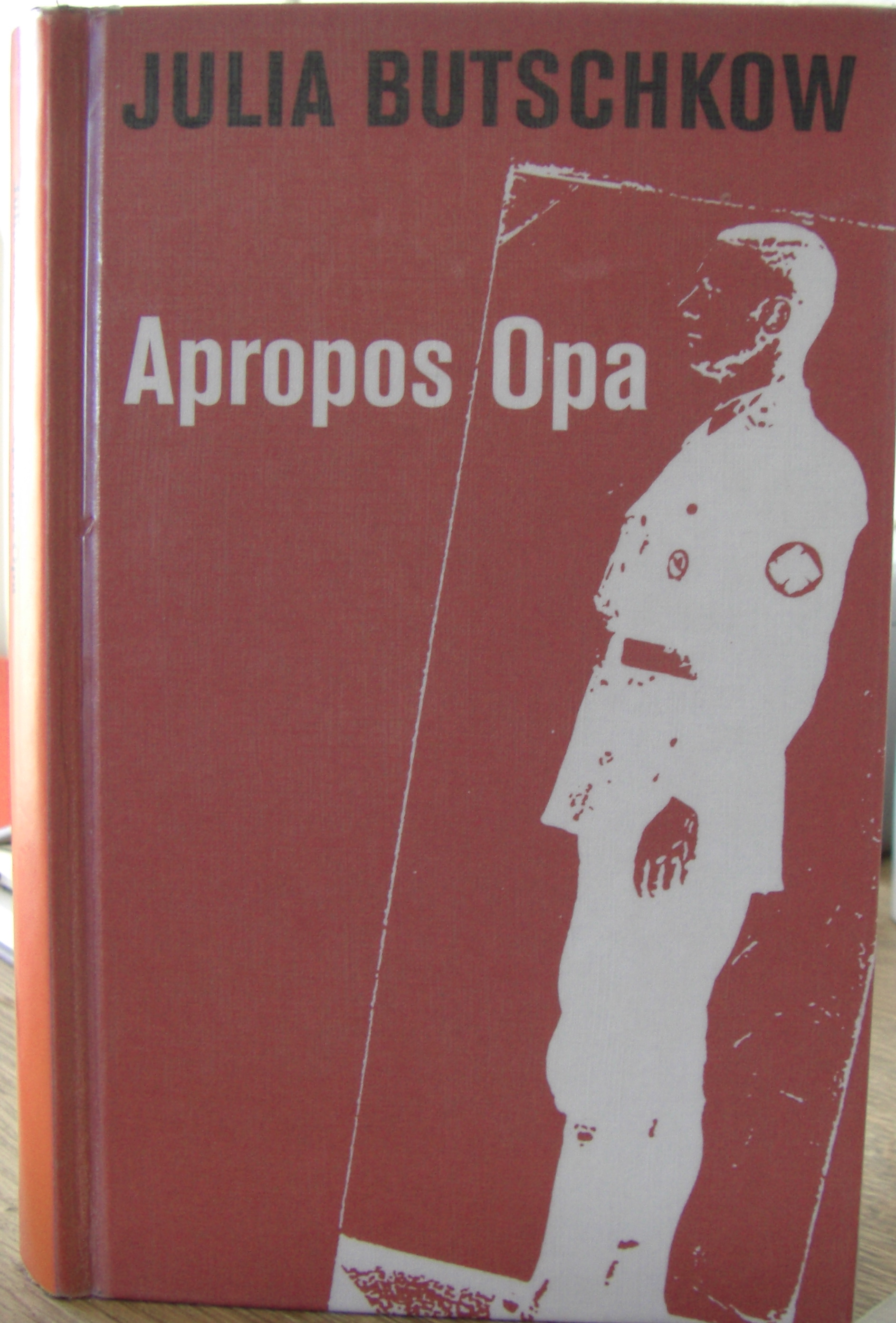
Julia Butschkow - Apropos Opa
Julia Butschkow has enrolled in the field of post-WWII literature with ‘Apropos Opa’, a story about a depressed woman working in a watchmaker shop, because studying literature at the university was too much.
Her father has ‘fled’ to Denmark from Germany and all that it stands for, denouncing it’s, and more importantly his father’s existence, while working at being as Danish as possible. She, an emotionally confused and apathetic woman, her father, psychologist and womanizer, and last but not least her grandfather, a (former) SS-officer turned alcoholic with bad parenting skills, form a basis for this novel that takes the reader from the end of WWII up to present day in shifts.
Butschkow writes in a minimalistic style that gets straight to the point or doesn’t at all. Chapters are short, and so are sentences. Sometimes there is the impression of something left unsaid, but existing very much in between the lines.
There is off course the obvious theme of guilt and shame where different mentalities lead to different solutions to the problem. The notion of being German (fully, partly or denying it) after WWII is a very complex entity. The questions ‘where were you during the war?’ or ‘what did you do?’ are so painful that some don’t want to be asked and others don’t want to be told. There is a process of rewriting your life or adapting it in unfavorable circumstances. How to deal with the fact that your father/mother/uncle was a Nazi, and knowing that there are several others in the land who must deal with the same fact, but no one is talking about it? Well, these days everyone is talking about it, through it. And Butschkow’s novel is a great input to the field. Also for the particular reason of the narrator being part German, part Danish. The narrator is being made aware of the negativity in her German heritage because of the way, for example, her Danish grandfather talks about them. She is ashamed without knowing exactly why.
The psychology goes further, because she also takes on the role of emotional caretaker to her father, thinking that no one can protect or understand her unstable father as she can. The scenes Butschkow describes of the narrator as child are heart-piercing and support the whole mental status of the grown up narrator. She is very emotionally attached to her father, which sometimes borders on a negative dependency. I get the feeling that she has never had her Oedipal moment with her father and thus doesn’t have a clear line between herself as individual and her father. In one part of the book she explains how she feels she and her father are in symbiosis, she feels what he feels, and reacts almost with physical distress if he is in a bad mood or uncomfortable.
And although she is center in the novel, it is very much a story of the father and grandfather as well. We are privileged in ‘knowing’ the narrator’s inner thoughts, but must draw conclusions about the other two on the basis of her memory and reenactments. And even though the judgement is on the basis of a proxy there is much to read from the three generations.
The story reads in parallels: father-daughter relationship, father-son relationship, dependency-autonomy, Danish-German, guilt and denial, etc. And there are continuously aspects worth analyzing and debating, so this has only been a few pointers.
This was a good read.
Sofi Oksanen
On March 30th the Nordic Council Literature Prize 2010 was awarded to Sofi Oksanen for her novel Puhdistus.

Sofi Oksanen - Renselse
I had planned for a long time to read it, as I read an interview with her and several reviews that spoke highly of the novel. Usually I don’t select my readings by reviews, but everything I read, both on and in between the lines, hinted at something special, so I reserved it from my library as soon as I could (and ended up only no. 24 in line!). I finally got it and read it in two days. I know it is every publisher’s press release orgasm wording, but it sucked me in and wouldn’t let go until I had read the last sentence.
The novel takes place in Estonia, where an elderly farmer woman Aliide finds a woman called Zara, a trafficking victim, battered and bruised on her property. The women’s different yet similar histories are told in a very harsh but poetic way. Every imaginable pain, guilt and shame that can befall a woman both in a political dictatorship and tyrannical misogynistic rule is present. But just so it doesn’t all become one color, the story also tells of pride, survival instincts and imagination. And it made me angry, it made me empathize and gag and smile and nod agreeingly. There were so many layers of female thoughts all coming together in the novel. And I say female thoughts, not to say it is an entity far from male thoughts, but only to emphasize that the novel deals with the female experience of a system set in order by men, in which it is almost impossible for them not to step outside the line and get penalized. Male dominance is pervasive and his sexuality is being used as a weapon against, and on, women in ways that make you cringe.
Something I found very interesting was how Aliide’s jealousy of her sister manifested itself in the book. It is, for lack of a more appropriate word, beautifully described. It represents a woman engulfed in her sisters assets and successes so much that her sister almost gains a divine glare, a virginal innocence towards all evil thought and behavior, only thence to manifest darkness so more blatantly in Aliide.
She is such a complex figure in my mind, and yet so cliché when it comes to the failures in sisterhood. Aliide knows what she wants, and she is determined to get it at all (and I mean seriously at ALL) costs. I think she represents a figure who balances on the very fine edge of desire and survival. She is determined to survive, even if that means that she has to give up so many things that could enrich her life. She survives but at a cost. Is it society’s fault? Men? Her own or her family’s?
And when she lashes out, takes control of her life, person and property , it is almost as if it is too little to late, or in a totally exaggerated way.
Another interesting and reoccurring scene is when the women experience assault and their mind, in survival mode, takes them out of this threatening situation. Being the little piece of dust or a fleck of light on the hard cement floor, fleeing into a hole in the wood, and with every sentence being read you, the reader, are painfully aware, but not explicitly told of the horrors that are inflicted upon them. I can’t recapitulate the intensity of these passages with as much fervor as Oksanen does, but they are worth the read.
There is so much to delve into in this book, so much to emphasize, but I don’t want to make this too long. Safe to say, I will be picking this book up again at some point in time.

On Instagram
